
Fragmentary insights
Reliving Romantic (capital R) inspiration, making an editorial “elbows up” suggestion, learning context about family history in Toronto, and sharing some stimulating urban conversations.

Fall 2025
It’s been kind of an intense autumn, but I am getting my newsletter in just under the seasonal wire. I’ve accumulated a lot of notes since the last one, so I hope readers will have patience – each section is small, rather like the fragments of novel and philosophy I talk about under Quotable (though I won’t pretend to be as eloquent or incisive as those writers), and so I hope the varied topics I explore can be digested and enjoyed in individual bites.
Musing
Earlier this fall, thanks to a reference in Spacing by my colleague John Lorinc, I read the book Unplanned Suburbs by the urban historian Richard Harris.
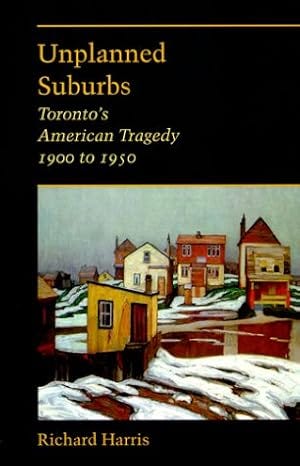
John noted that the book is largely about Earlscourt in the early 20th century, and it piqued my interest because I have family history there. My great-grandfather, the Reverend A.J. Reid, was the rector at St. Chad’s, the Anglican church in Earlscourt, in the early to mid 20th century. He had emigrated from England in the late 19th century and, despite being an immigrant with no particular pedigree, managed to marry into a well-established old Toronto family, the Merediths. He became rector of a church in Campbellford, Ontario (where my grandfather was born), but apparently wanted to move back to the big city. The family legend (possibly apocryphal, or at least much elaborated over the years) is that he got a chance to preach at one of the wealthy establishment churches in Toronto, perhaps through the influence of his wife’s family. But – in a streak of stubborn idealism that also manifested in his descendants, my grandfather and father – the story goes that he gave his sermon to this very upscale audience on the subject of Matthew 19:24, “it is easier for a camel to go through the eye of a needle than for a rich man to enter the kingdom of God.” He did not get that job. Instead, he ended up rector of St. Chad’s, which, as Harris shows, was in one of the poorest, working-class parts of the city.
Harris explains that the area was on the outskirts of the city, with few or no services, and working-class families, mostly from the British Isles, could afford to buy small plots of land and build literal shacks to live in, which they would then improve over time into full houses. A fascinating aspect of the era that Harris brings out is that zoning at the time was largely private. Land companies would target specific areas to specific classes, with high-end areas such as Lawrence Park divided into large lots with strict conditions set in the land sale about setback, building materials, and land use for any houses built there, whereas areas aimed at the working class had small lots and no conditions at all. These private decisions shaped the nature of Toronto’s neighbourhoods long before more formal municipal zoning was introduced, meaning that for a lot of properties in Toronto, zoning was effectively retroactive.
I wrote about this and other insights from the book on the Spacing blog.

The Sneak Peek
The construction of the Eglinton Crosstown LRT has been a long, drawn-out, brutal marathon, but the finish line is finally in sight sometime early in the new year. To mark this significant new transit line, at Spacing we’ve dedicated our next issue to Eglinton Avenue. As I write in my editor’s introduction, in some ways this issue is a companion to our Yonge Street issue a year ago – if Yonge is Toronto’s spine, then Eglinton might be the city’s prime rib, connecting the city horizontally through its geographical centre. Our issue follows the street more or less from east to west, exploring the very different shapes it takes across town, from Little Afghanistan in Scarborough to the never-born Richview expressway in Etobicoke.
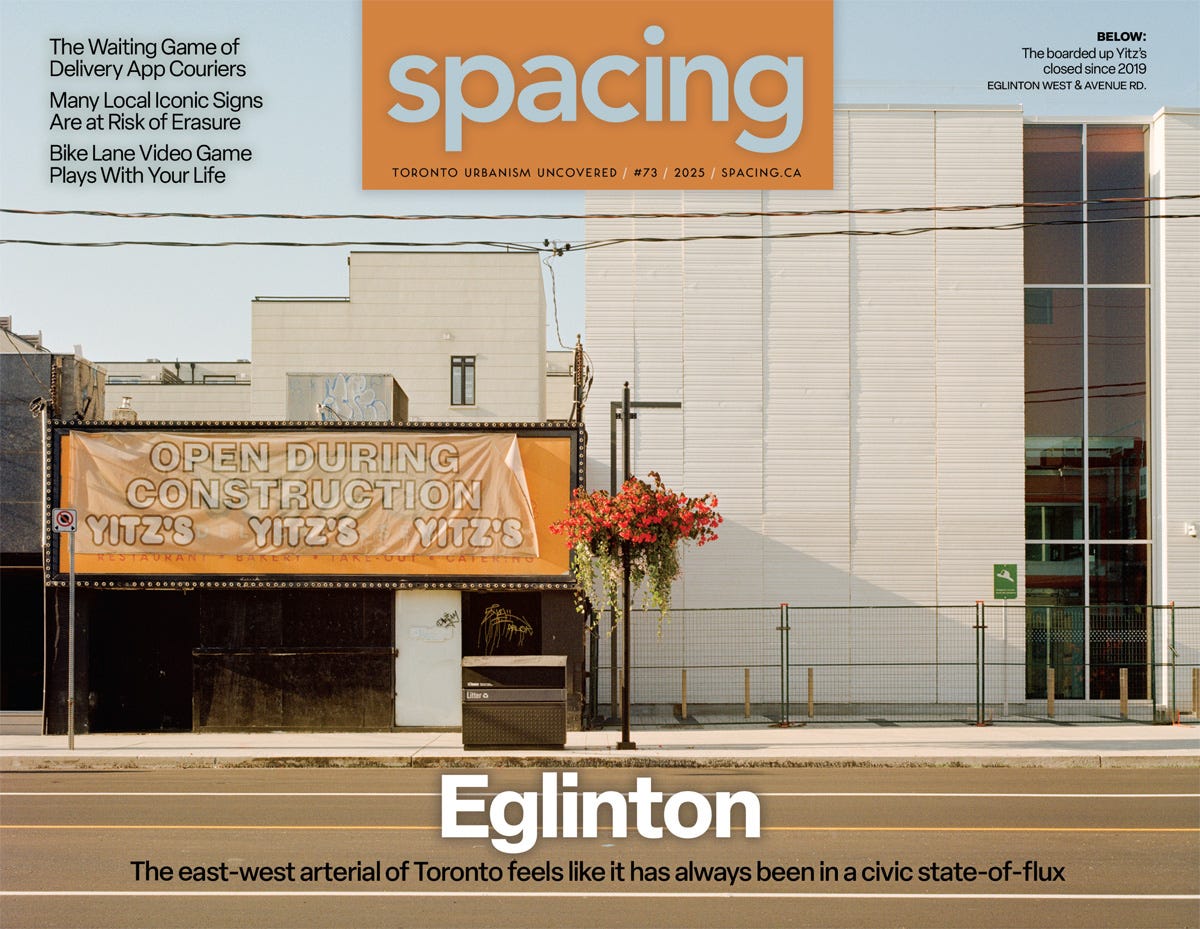
For me, a key potential with the new LRT is establishing a Toronto-style pedestrian scramble intersection at Yonge and Eglinton, where pedestrians can cross at all phases but have one exclusively for them. Although Yonge and Eglinton gets even more pedestrian traffic than Yonge at Dundas and at Bloor, which have those scrambles, it didn’t get one in the past in part because of how many buses needed to use the intersection. But now that most of the transit is underground, far more people are crossing there on foot than in vehicles. Staff unexpectedly and incoherently tried to shoot down an attempt in the fall to get this idea going, despite the intersection meeting all the required criteria (I deputed at the Infrastructure and Environment Committee about it), but City Council will revisit the idea once the LRT is actually active. For me, not only would a scramble give pedestrians priority and safety at possibly the busiest pedestrian intersection in the city, but it would signal an ambition for Toronto to look to the future of urbanism.
The Tidbit
In December, a group of Canadian linguistics experts wrote to Prime Minister Mark Carney (PDF) to express concern that the federal government had started using British spelling rather than Canadian spelling, in particular “-ise” rather than “-ize” endings, in recent publications, notably the budget.
One might suppose that this change was influenced by Carney’s many years in England, both as a graduate student and as head of the Bank of England.
But my theory is simpler: Microsoft Word, the default word processing program for almost everyone, sets its “English (Canada)” language setting to simply allow both US and UK spellings. So if you’re using “Canadian” spelling, it will allow both analyze and analyse (I am using Word’s “Canadian” language to type this and neither of them got a squiggly red line).
So the result is that in Word’s “Canadian” setting one can use American spelling (e.g. labor – also no squiggly red line as I type) and not notice it. In a supposedly “elbows up” era when we are trying to reduce American influence, the only way to detect accidental US spelling is to set your document to “English (United Kingdom).” I suspect that’s what federal public servants have been directed to do. And public servants who aren’t particularly aware of Canadian spelling are simply following the spelling they’re directed to by the UK setting.
The actual solution is for the Canadian government to pressure Microsoft to introduce a truly Canadian language setting. There are 40 million people in Canada – it’s surely reasonable to cater properly to us. And, as the letter indicates, sufficient reference resources exist in order to set that up.
Coda: as an editor, a word of advice to writers who mostly submit to Canadian publications – set your default language to “English (Canadian)” rather than the factory default “English (United States).” That way your spellcheck won’t put a squiggly red line under Canadian spellings when you write a piece. It’s still up to you to know Canadian spelling, of course, until Word creates a true Canadian dictionary.
What’s Up
I got interviewed on the Hidden Gems Toronto podcast with my Spacing colleague Matt Blackett about the story of the magazine.
Listen to “GOOD SPACES CREATE GREAT PLACES: A magazine and a retail store combine to change how we view Toronto” (31 minutes).
And, as the author of the Toronto Public Etiquette Guide, I talked to writer Liisa Ladoucer for an online story aimed at orienting visitors to the World Cup next year to Toronto’s public etiquette.
Quotable
“Fritz had been born a dreamy, seemingly backward little boy. After a serious illness when he was nine, he became intelligent ...”
– Penelope Fitzgerald, The Blue Flower
I rather relate to this quotation, although fortunately I didn’t have to become sick to become intelligent. I was a hopelessly dreamy child (those early report cards talked about how I was never really paying attention in school), but then they gave us some of those aptitude tests in grade 5 or 6 and suddenly I was being sent to enriched classes (where I still daydreamed).
Fitzgerald’s novel is about the youth of the German Romantic writer and philosopher Novalis (real name Friedrich von Hardenberg). I read it because, at the beginning of this year, I was hired by University of Toronto professor Owen Ware to edit his extensive introduction to his translation of Novalis’s unfinished novel, Heinrich von Ofterdingen, which opens with a dream about a blue flower. In Fitzgerald’s novel, named after that flower, among other things Novalis shares this opening scene with various other characters, who try to understand the meaning of this rather mystifying vision.
I was excited to receive Ware’s offer because my favourite course as an undergraduate was on the Romantic movement (through the Literary Studies program at Victoria College). The project triggered happy memories of that course, including our reading of a charming fragment by Novalis – I don’t remember what it actually said, but I do remember how much I’d enjoyed it. As it happened, I had not realized that just before I started reading the novel, Simon Haisell, whose guided slow read of War and Peace I enjoyed last year, had just finished leading a slow read of The Blue Flower. From his introduction, I learned that Novalis’s philosophical writings are primarily in the form of these kinds of fragments, and that the short, fragmentary chapters of Fitzgerald’s novel reflect that structure.
The Romanticism course I took as an undergraduate was a wonderfully interdisciplinary course that combined literature, philosophy, art, and music in a hugely stimulating manner. The course was taught by Jean Wilson, a lively and enthusiastic teacher who was then a PhD student. Inspired by my work with Prof. Ware, I looked her up, and discovered she had been teaching at McMaster University, until recently directing the Arts and Science program there (which my cousin’s son Luke was just finishing). She replied to my email – remembering me, flatteringly – and explained that the course had been designed by her co-supervisor, Cyrus Hamlin, and she had taken it over when he left for a different university. It was the last year the course was taught, I think, so I am grateful I caught it on time. It was Wilson who reminded me about Fitzgerald’s novel, which prompted me to read it.
It’s thanks to that course that I am an enduring fan of the painter Caspar David Friedrich, whose work embodies so many of the themes of Romanticism. On a trip to Germany a couple of years ago, my wife and I and our friends in Germany visited Germany’s relatively remote Baltic coast and the island of Rügen, inspired by Friedrich’s growing up on that coast and his sublime painting Chalk Cliffs on Rügen (a print of which hangs on my office wall). We visited the chalk cliffs themselves – now a UNESCO heritage site – which are as sublime as the painting depicts, if rather more busy these days, and are reached through an ethereal beech forest. The entire area, in fact, had a sense of the wild and mysterious that is so much a part of Friedrich’s oeuvre.

Novalis’s novel itself – which I feel like I know through Ware’s discussion, though I will need to wait for the translation to actually read it – is equally mysterious and wild, as well as being unfinished, creating that same sense of strangeness, yearning, and transportation into a different plane of existence as Friedrich’s paintings. You can find out more about it in Ware’s developing website to accompany his edition.
The way all of these different threads came together around this project reminded me of the way different disciplinary threads came together in that memorable course so many decades ago.
Pic Pick
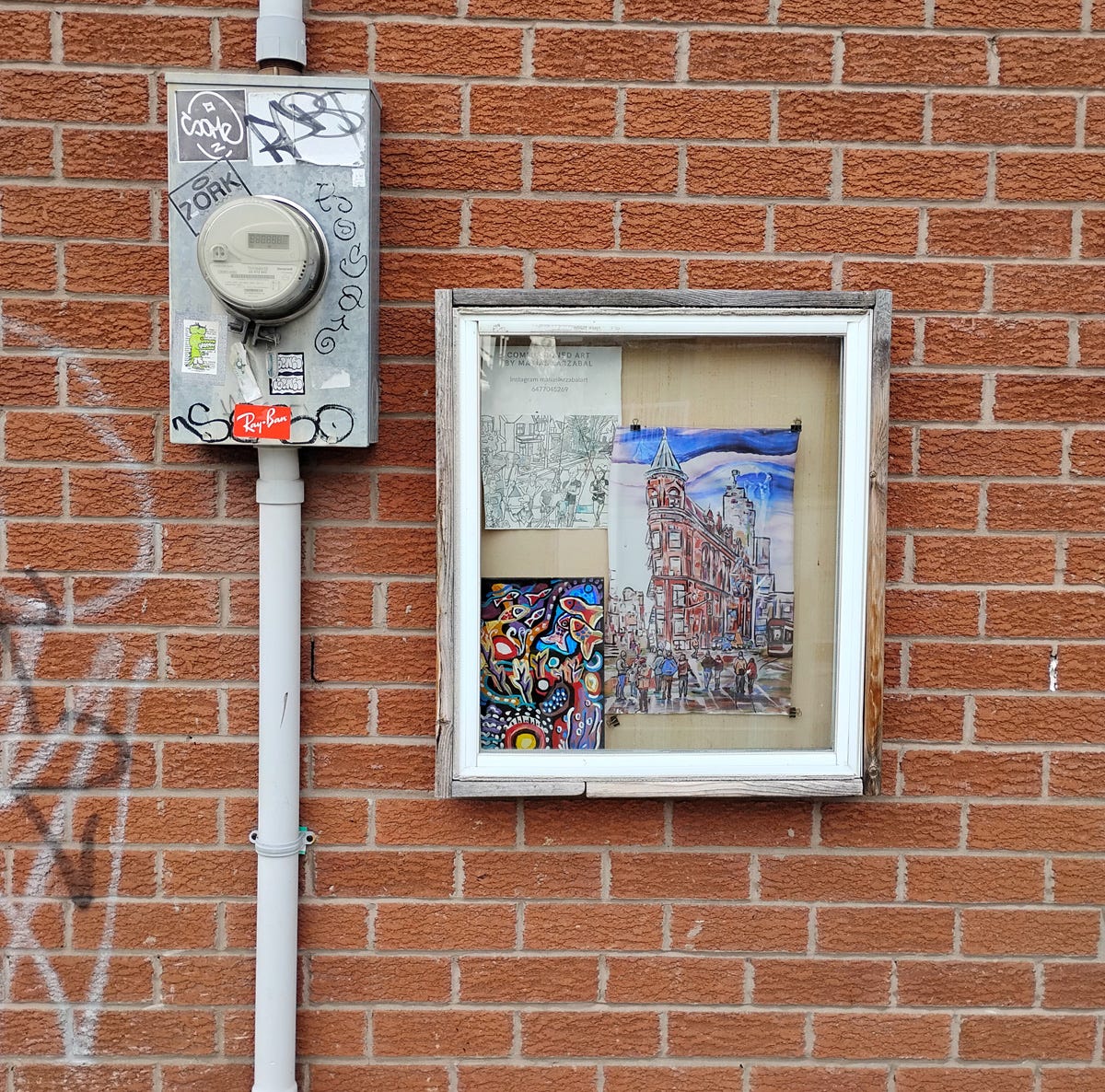
We see little free libraries everywhere – what about a little free art gallery? I’ve often thought a little public display case for art or posters would be a neat idea that contributes to the visual landscape. And then, on a walk up Dovercourt, I spotted this one on the side wall of a building, so that you see it as you walk north. A nice touch.
The Catch-Up
One of the joys of editing the book Messy Cities: Why We Can’t Plan Everything was the wonderful conversations with my co-editors Zahra Ebrahim, John Lorinc, and Leslie Woo in our regular meetings as we worked on the book. We had the right combination of similar interests and different experiences and perspectives that creates stimulating and positive discussions.
So it was great to have Spacing Radio podcast host Glyn Bowerman get three of us together again (albeit on Zoom) after the book came out to get us talking again about the ideas in the book. Glyn got us back into that spirit of lively conversation, and we had a chance to reflect on the concept of messy urbanism and what we learned through bringing the book together.
Messy Cities continued to get some great attention over the fall, including a deep review in the Literary Review of Canada by Vancouver-based writer on urban issues Frances Bula, paired with the new book by the eminent urban historian Richard Harris, who I wrote about above.
Read “Building Blocks: Won’t you be my neighbour?” by Frances Bula in the Literary Review of Canada.
Messy Cities also got some year-end love. Canadian Architect magazine included it in its “Best books for Canadian architects: 2025” feature. And we were excited to learn that Messy Cities made the list of the 25 top selling books by Canadian-owned publishers in independent bookstores in 2025, at #23! That’s a fairly specific set of criteria, to be sure, but it includes both fiction and non-fiction titles, and it’s gratifying just to be on any annual bestseller list.
The Shout-Out
A decade ago Steve Paikin, who just recently retired host of TVO’s The Agenda, had lunch with my father, Tim Reid, a former member of Ontario’s provincial parliament, and wrote a charming article about him. My father was both an athlete and a politician, combining two of Paikin’s enduring enthusiasms. After my father died this fall, Paikin very thoughtfully reworked his article into a lovely tribute. My family were very moved by this kind gesture.