
Back to Life
As spring arrives, a strawberry and a theory come back from oblivion, and a book is launched.

Spring 2025
Life got in the way of my newsletter again, so this one is seasonal rather than month-based. It’s been an intense few months both in terms of family support and in terms of work, but I wanted to share some recent and upcoming news, and some thoughts inspired by a spring flower. Sometimes something – a plant, a theory – seems to die off, but then comes back stronger.
The Tidbit
Inspired by my slow read of War and Peace last year, and by my wife’s reading of it in the original Russian, I decided to do a personal slow read on my own this year of another intimidating 19th century novel – this time in French, my second language. I chose Honoré de Balzac’s Le Père Goriot – I was originally intrigued by it because Thomas Piketty cites it a lot (along with Jane Austen) in his book Capital in the 20th Century (it is, indeed, all about how to gain capital). I’ve also always been intrigued by Balzac’s project of many interrelated novels giving a portrait of a society, and this is possibly the most famous of novels.
In the spirit of the slow reading, I am making myself look up words I don’t know, even if I can generally get a sense of the overall direction of the story. Balzac has an admirably wide vocabulary, and one thing I’ve learned is that the French have a remarkable number of words for mud (and related concepts – muck, swamp, etc.). It seems to have been omnipresent in 19th century Paris.
I’ve long been intrigued by the idea that languages reflect their speakers’ environments and obsessions in their vocabulary, although for a long time the classic exemplar, that the Inuit had a hundred words for snow, was considered an urban legend. But it turns out it’s actually true – not a hundred, but a lot more than average – according to a new study.
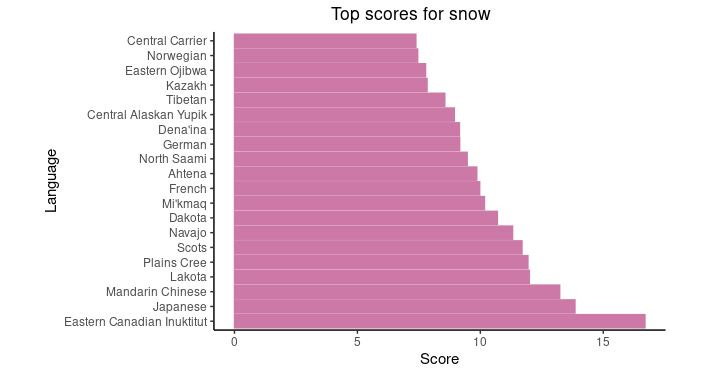
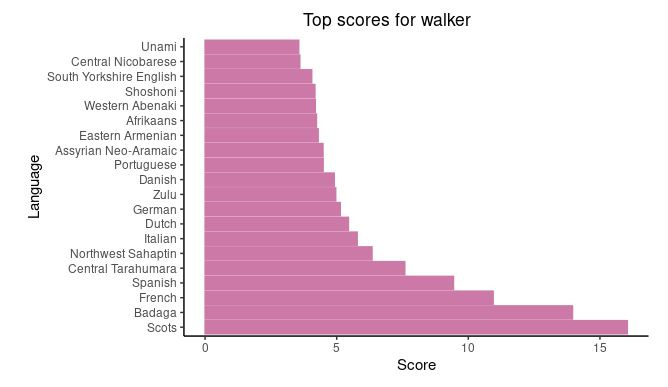
I was interested in this idea because it seems to me that English has a remarkable number of words for “walking,” one of my passions. I made a list and came up with around 70. The study in question was based on comparisons with English, so didn’t actually measure English itself, but there’s some support for this idea in that Scots (a related language and environment) has by far the largest proportion of words for “walker” of all the languages studied (from the study’s supporting Lexical Elaboration Explorer).
The same charts show that French doesn’t rate for “mud” (the Scots are way up there as well, though). Perhaps it stands out in Balzac because he, a true misanthrope, basically thinks society is a mucky swamp, so he’s a bit obsessed with the concept both literally and metaphorically. You could say it’s one of Balzac’s top vocabulary concepts, even if it’s not for French in general.
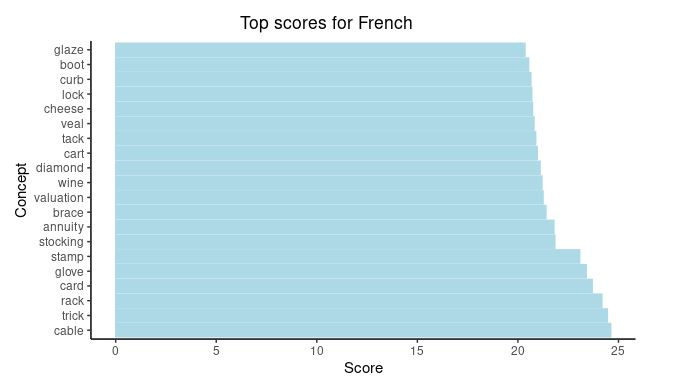
It turns out the French top frequent-word concepts are in fact mostly about food and dress, plus tricks (the French love a trickster), so that rather fits stereotypical expectations. (Not sure what the cable is about.)
What’s Up (1)
In my previous newsletter, I announced the imminent publication of the book I co-edited, Messy Cities, and a bit of the story of its inception. Now I’m excited to announce the launch party! We’ll be launching the book on June 3 at Henderson Brewing Company, a brewery and event space on Sterling Road, an formerly industrial enclave between train tracks that now houses a mix of museums, retail, industrial, and housing – an appropriately messy bit of the city. All my co-editors will be there, and many of our contributors will be there too – and of course the book will be on sale. It will be fun! We’re at the moment enjoying setting up a playlist of messy cities-themed songs. Please join us to celebrate.
The event is from 7-9 on June 3 at 128A Sterling Rd, Toronto. More details here – you can register to get a reminder, but there’s no need to, you can also just show up.

What’s up (2)
For the past couple of provincial elections in Ontario, I’ve charted how the election played out in Toronto itself. So after the provincial election this year, I did the same calculation.
It’s interesting that Toronto’s electorate has cycled through the three major parties in these three elections, with the NDP winning the most votes in 2018, the Conservatives winning the most in 2022, and the Liberals winning the most votes in 2025. However, unlike the past elections where getting the most votes resulted in a leading number of seats, in 2025 the Liberals still had the fewest seats in Toronto of the major parties despite getting the most votes, even if they gained three seats. The NDP, meanwhile, had a remarkably focused vote, winning comfortably in all but one of their seats but not getting many votes in most of the other seats.
Read “Toronto in the 2025 Ontario election” on Spacing.ca
It also makes for an interesting contrast with the 2025 federal election that took place almost exactly two months later, where the NDP vote collapsed even in seats that are usually Liberals vs NDP, where strategic voting against the Conservatives wasn’t needed. Remarkably, in all but one of the seats the NDP won provincially, they actually came third behind the Conservatives in the federal election, which is a notable change from the past. The Liberals, meanwhile, won all but one of Toronto’s seats. While this is a notable contrast with the provincial result, it does reflect the fact that their vote was spread out in both elections – it makes them contenders in all Toronto seats, but at the same time makes them vulnerable to not getting enough votes in most.
(To address this kind of problem, I once proposed a somewhat original “wildcard” proportional representation system tailored to a primarily first-past-the-post system. The result this year made me consider some variations to my original concept.)
Pic Pick
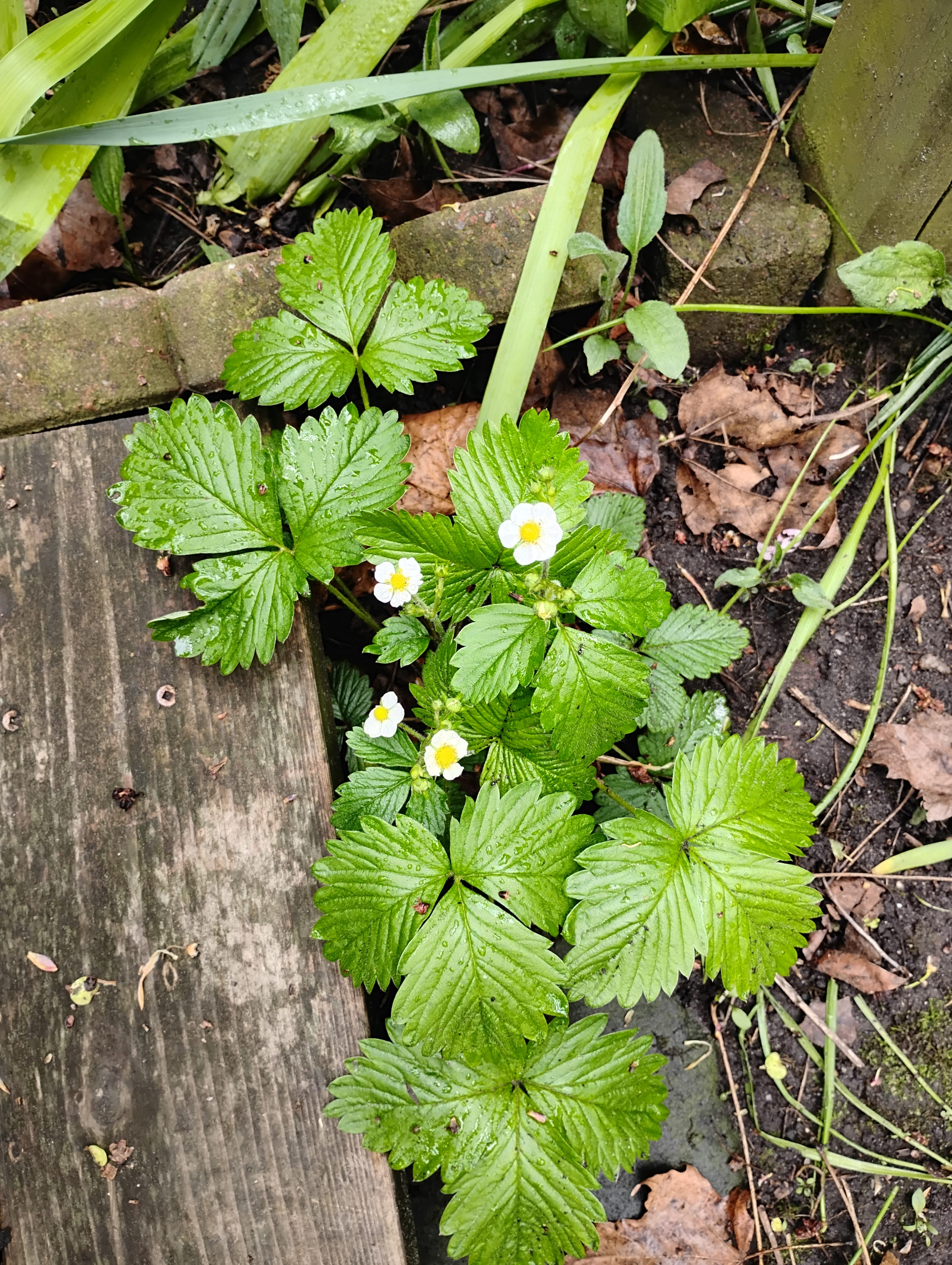
This native wild strawberry plant volunteered to join our garden a few years ago – it just showed up, inserting itself in a somewhat awkward location at the base of our porch steps. We’ve had several volunteer plants join our garden like this, often in places where nothing much would grow before – including a thriving ornamental quince tree in the shade of a lilac tree. As long as they contribute to the garden (a subjective judgment, I admit), we like to let them grow – we figure, if they have found a spot where they thrive, then they are clearly a good choice for that spot. And while the tiny berries on this one aren’t flavourful, the little flowers that precede them are just so charming.
The strawberry didn’t show up last year, and I was worried we’d lost it – but it seems it was just taking a sabbatical, and has come back this year stronger than ever.
Wild strawberry, as it happens, is one of the plants I helped plant in the Middle Mill patch of the Don Valley that I sometimes help with as part of Toronto Nature Stewards. The goal is to plant robust native plants to try to displace the invasive species, like dog-strangling vine, that took over parts of the valley after industry departed (the site was once the location of a factory – only bits of rubble and one old furnace hidden in the woods now remain). I recently learned there’s a word specifically for plants that grow in these kinds of places – ruderal – meaning plants growing in waste places or disturbed land, from the Latin rudus (rubble).
It’s an interesting paradox – trying to purposefully re-wild in the face of an existing wild plant – but the goal is to avoid a monoculture and instead support a diversity of plants that supports a healthier ecosystem for plants, insects, and animals. One might see in this a metaphor for economics – the dangers of monopoly and the need to actively enforce competition laws to ensure competition and diversity for a healthy, robust economy. You could even think of it as having a bit of a messy cities vibe.